
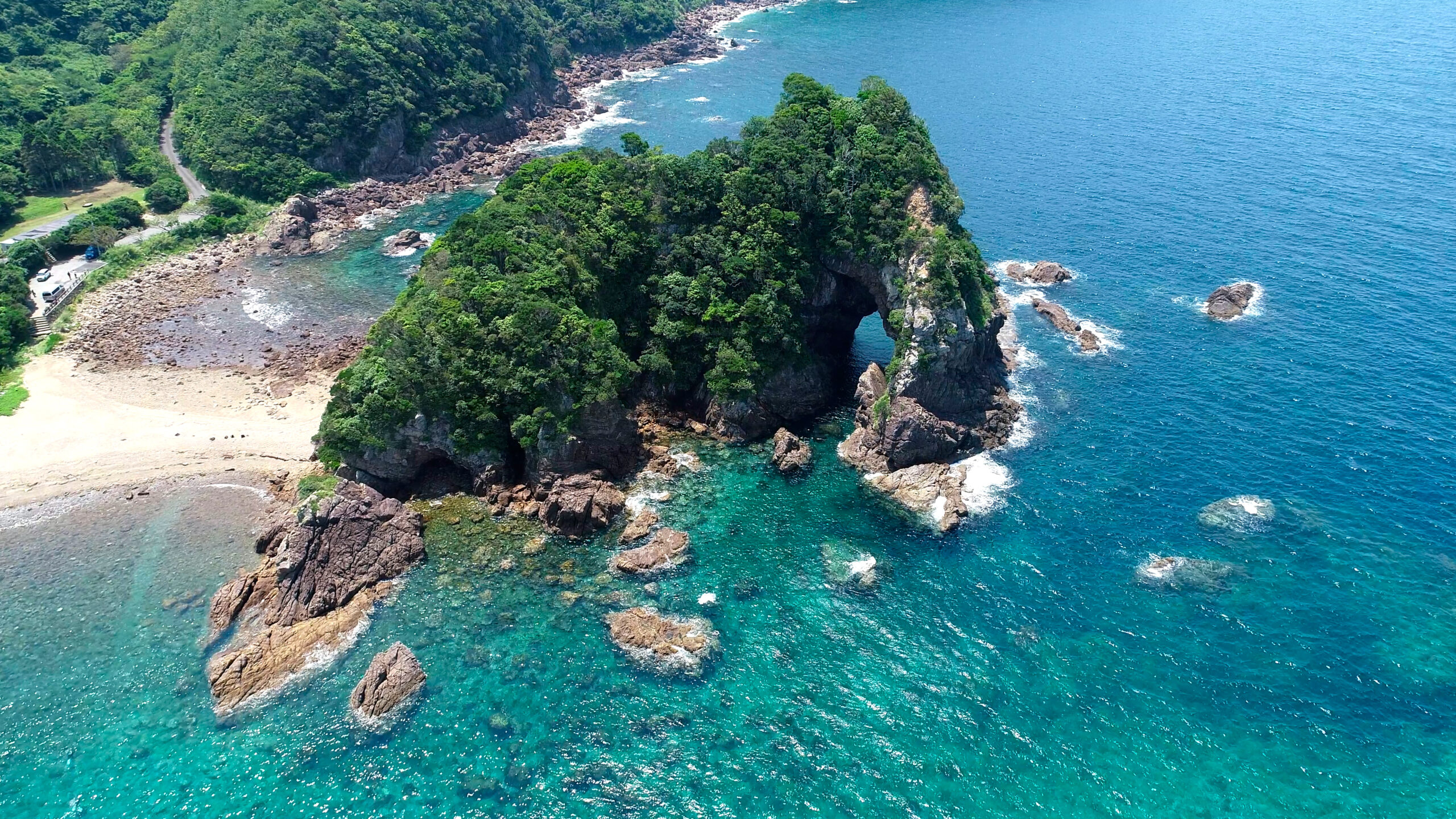
The clear blue sky and the cobalt blue sea that changes its appearance depending on the time and place. And the coastline and strangely shaped rocks that have been etched since ancient times are the memories of a vibrant Earth.
Why not take a look at the natural beauty of Unzen-Amakusa National Park from the sky?

Amakusa Gokyo [Kami Amakusa City]
The Amakusa Five Bridges are the gateway connecting mainland Kumamoto and the Amakusa Islands. Five unique bridges, each with a different structure, link the islands. With emerald green seas overlooking Matsushima Island and numerous scenic viewpoints, you can enjoy the natural beauty and island-hopping charm of Amakusa while driving or cycling.
Takamokujima [Kami-Amakusa City]
Takamokujima is a small, uninhabited island floating in the sea off Kamiamakusa City, and is one of the representative landscapes of Amakusa Matsushima. A major attraction is that a path to the island appears from the sea for only a few hours at low tide, allowing visitors to walk across and enjoy a special experience of becoming one with nature. Recently, it has become a popular photo spot, known as “Amakusa’s Mont Saint-Michel.”
Senganzan [Kami-Amakusa City]
Mount Senganzan is a 162-meter-high mountain located in Kamiamakusa City, overlooking Amakusa Matsushima, and is known as an easily accessible viewpoint. From the summit, you can enjoy a panoramic view of the Amakusa Five Bridges and the beautiful archipelago scenery. There are also well-maintained walking trails in the surrounding area, making it a relaxing place to enjoy the nature of Amakusa while strolling or hiking.
Taromaru-dake and Jiromaru-dake [Kami-Amakusa City]
Taromaru-dake and Jiromaru-dake are twin rocky peaks located in Kamiamakusa City. Their charm lies in their sheer cliffs and varied hiking trails, offering a diverse range of routes including the zigzagging Inazuma-gaeshi and the Jiro-otoshi, where you climb large rocks using ropes. From the summit, you’ll be treated to a breathtaking 360-degree panoramic view of the Amakusa Islands and Mount Unzen!
Ryugatake [Kami-Amakusa City]
Mt. Ryugatake is a 470m-high mountain located in the southern part of the Amakusa Islands, and is a popular hiking spot rich in nature. From the summit, you can enjoy a spectacular view of the Shiranui Sea, the islands of Hishima and Goshoura, and even Shishijima and Nagashima in the distance, making it one of Amakusa’s most representative scenic spots. At the summit, there is a large rock with a heart-shaped indentation, which has made it a popular power spot.
Myokenura [Amakusa City]
Myokenura, a nationally designated scenic spot and natural monument, is a representative landmark of the west coast of Amakusa. The powerful landscape of sea cliffs and strangely shaped rocks created by rough waves unfolds before you. From south to north, there is a series of strangely shaped rocks and sea caves, including Jusanbutsuzaki, Myoken-iwa, Nagahae, Horaijima, Onigaura, Tsunobashi, Eboshi-iwa, and Genbuzaki, making it one of the representative sights of Unzen-Amakusa National Park.
Shigekushi Coast [Amakusa City]
Mogushi Beach boasts natural white sand and some of the clearest waters in Kyushu. The shallow, emerald-green sea is a natural paradise teeming with coral reefs and tropical fish. Sea turtles sometimes come here to lay their eggs in May and June. It is also known as a filming location for the NHK historical drama “Musashi”.
Near Satsuki Beach [Amakusa City]
This crescent-shaped white sandy beach stretches for 1km and is a highly recommended beach that is accessible to everyone, with ramps for wheelchairs. There are also plazas and parks nearby, making it a safe place for both children and adults to play. On the way, crossing the 883m-long Ushibuka Haiya Bridge, which soars over Ushibuka Fishing Port, is a truly exhilarating experience!
Tsurubayama Enchi (Marine Park) [Amakusa City]
This park is located on the southernmost cape of Amakusa. It offers a panoramic view of Nagashima Island in Kagoshima Prefecture. In spring, it is one of Amakusa’s famous cherry blossom viewing spots, with approximately 1,000 cherry trees in full bloom. Every year from March to April, the trees reach their peak, attracting many visitors who come to enjoy the blossoms.
